Bitcoin is facing renewed selling pressure as nearly 50,000 BTC were transferred to cryptocurrency exchanges at a loss within a single day, raising concerns that short-term investors are beginning to capitulate. Combined with weakening institutional demand and a challenging macroeconomic environment, the latest on-chain data suggests that the world’s largest cryptocurrency could remain vulnerable to additional downside in the near term.
Recent blockchain data indicates that short-term Bitcoin holders are experiencing increasing financial stress. According to on-chain analytics, the realized market capitalization of investors who purchased Bitcoin within the last 155 days has declined to approximately $237.7 billion, marking its lowest level since October 2024.
This metric measures the value of Bitcoin held by recent buyers based on the price at which their coins were acquired. The latest decline suggests that a significant portion of these investors is now holding unrealized losses, a situation that often increases the likelihood of panic selling during periods of market weakness.
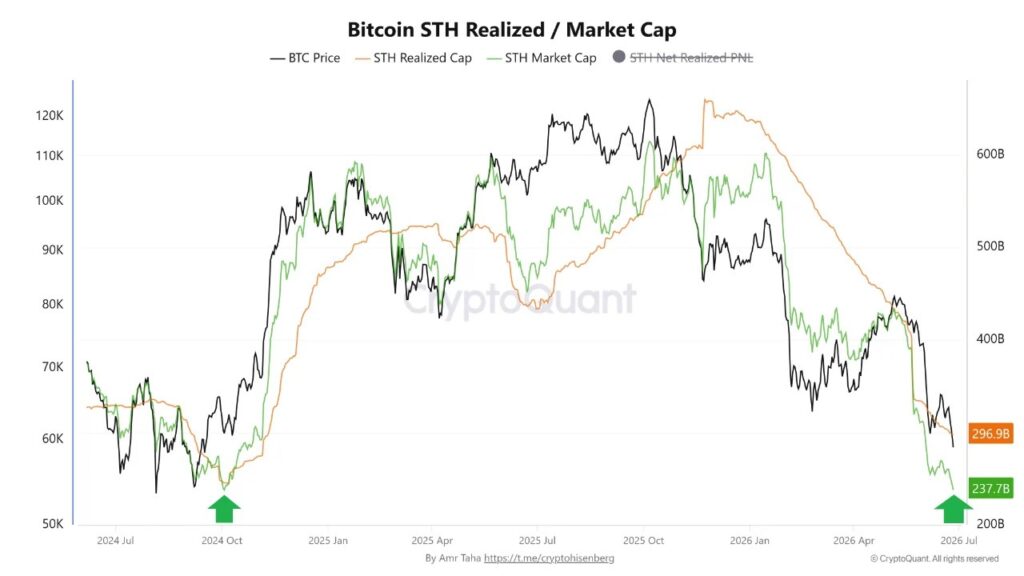
A similar pattern emerged during Bitcoin’s correction in late 2024, when declining short-term holder valuations eventually coincided with a major market bottom. However, analysts caution that the current data should be viewed primarily as a sign of elevated investor stress rather than confirmation that Bitcoin has already reached its lowest price.
Adding to these concerns, approximately 50,000 BTC owned by short-term holders were transferred to cryptocurrency exchanges while sitting at a loss over the past 24 hours. This represents the largest loss-driven exchange inflow since early June and reflects growing sell-side pressure from newer market participants attempting to limit further losses.
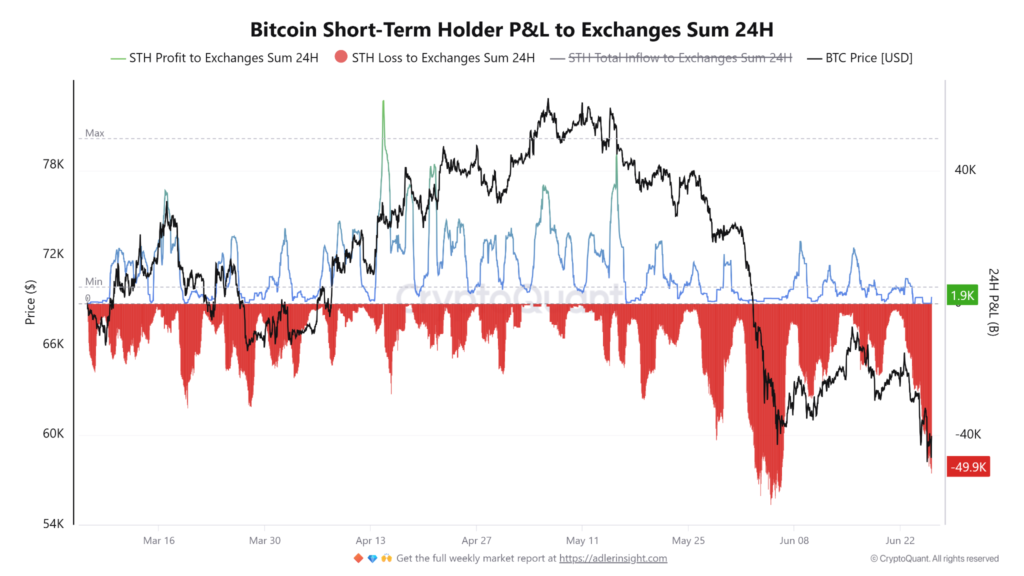
Among major trading platforms, Binance recorded nearly 9,500 BTC arriving under similar conditions, highlighting that many recent investors are choosing to exit their positions as Bitcoin struggles to regain upward momentum.
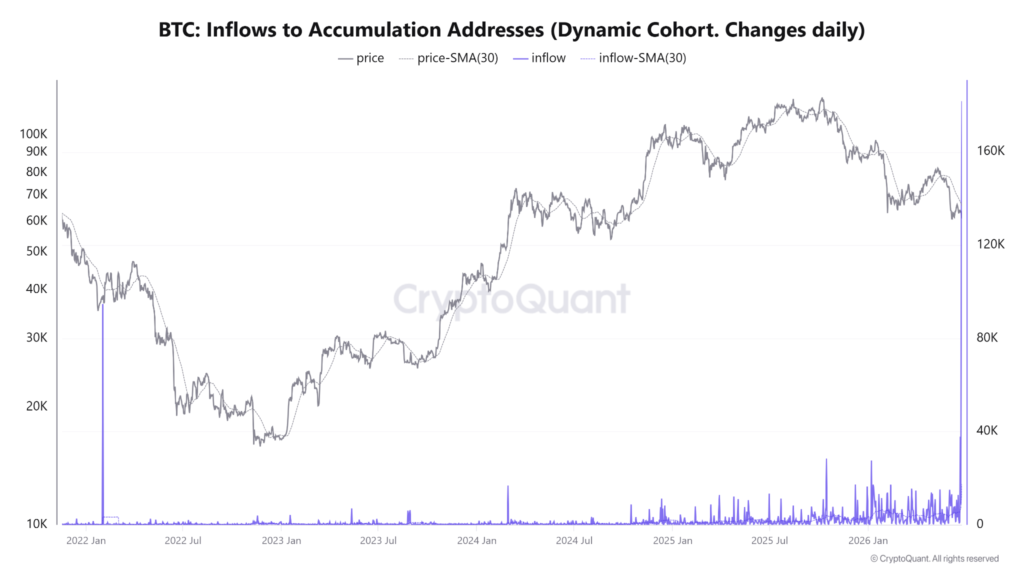
Despite the increased selling activity from short-term holders, long-term investors continue to display confidence in Bitcoin’s future. On-chain data shows that accumulation addresses received a record 181,000 BTC during the latest reporting period, nearly doubling the previous record established in 2022.
Accumulation wallets typically belong to investors who rarely spend or sell their holdings, making this surge an encouraging signal that experienced market participants continue to absorb available supply while weaker hands leave the market. This divergence between short-term sellers and long-term buyers has historically been observed during periods of market consolidation.
Beyond blockchain activity, broader macroeconomic conditions continue to create headwinds for Bitcoin and other digital assets.
Institutional demand has remained relatively weak, with the Coinbase Premium Index staying below zero for more than 40 consecutive days. Since Coinbase is widely used by professional and institutional investors in the United States, a persistent negative premium suggests that institutional selling pressure continues to outweigh buying activity.
Economic data released in the United States has also reduced expectations that the Federal Reserve will begin cutting interest rates in the near future. Inflation readings came in slightly above forecasts, while economic growth exceeded expectations, reinforcing the possibility that monetary policy could remain restrictive for longer than previously anticipated.
Higher interest rates generally reduce investor appetite for risk assets such as cryptocurrencies by increasing borrowing costs and making traditional fixed-income investments more attractive.
Market analysts believe this combination of elevated inflation, stronger economic growth, and tighter monetary policy creates one of the most challenging macroeconomic environments Bitcoin has faced in recent months.
Another factor drawing attention is Strategy, one of the world’s largest corporate Bitcoin holders. The company has accumulated approximately 174,300 BTC during 2026, financing much of these purchases through preferred equity offerings and common stock issuance.
However, recent financial data suggests that funding conditions for Strategy have become more difficult. The company’s preferred shares have traded at a substantial discount to their original value, while its available cash reserves have declined significantly following debt repayments. At the same time, annual dividend obligations have increased considerably, reducing the firm’s financial flexibility.
Because Strategy has been one of Bitcoin’s most aggressive institutional buyers, any slowdown in its purchasing activity could remove an important source of market demand.
Although long-term accumulation remains strong, the sharp increase in loss-driven exchange inflows, weakening institutional participation, and persistent macroeconomic uncertainty suggest that Bitcoin may continue to experience heightened volatility in the coming weeks. Investors will likely monitor upcoming economic data, Federal Reserve policy decisions, and institutional buying activity to determine whether the current correction develops into a deeper decline or establishes the foundation for the next recovery.