Candidates supported by cryptocurrency-funded political action committees (PACs) achieved several important victories in recent U.S. primary elections, highlighting the growing influence of the digital asset industry on American politics. With millions of dollars invested in campaign advertising, crypto-backed organizations continue expanding their efforts to support lawmakers viewed as favorable toward blockchain innovation and digital asset regulation.
Several congressional candidates endorsed by cryptocurrency-focused political organizations won their party primaries in New York, Maryland, and Utah, positioning themselves for the upcoming general elections in November.
The victories represent another milestone for the crypto industry’s increasingly organized political strategy, as major blockchain companies continue investing substantial resources to influence future legislation affecting digital assets in the United States.
Leading the campaign spending was Fairshake, one of the largest cryptocurrency-backed political action committees in the country. Together with its affiliated organizations, the group spent approximately $8 million on television, digital, and media advertising to support candidates considered supportive of cryptocurrency innovation, blockchain technology, and clearer digital asset regulation.
Fairshake receives significant financial backing from major cryptocurrency companies, including Coinbase and Ripple Labs, and has become one of the most influential organizations representing the industry’s interests during federal elections.
Among Tuesday’s winners was Ritchie Torres, the Democratic candidate representing New York’s 15th Congressional District, who secured a decisive primary victory with nearly 72% of the vote. Torres has consistently voiced support for blockchain innovation and has become one of the most prominent pro-cryptocurrency lawmakers currently serving in Congress.
In Utah’s 2nd Congressional District, Republican candidate Blake Moore also won his primary election after receiving approximately 57.5% of the vote, advancing to the general election later this year.
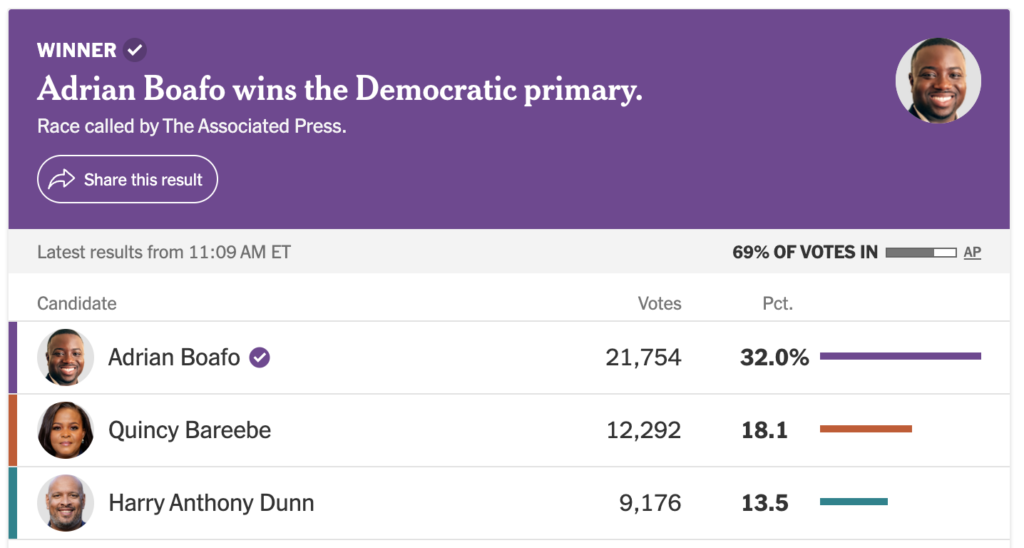
Another closely watched race took place in Maryland’s 5th Congressional District, where Democratic candidate Adrian Boafo secured victory despite facing criticism from opponents over cryptocurrency industry campaign spending.
Fairshake affiliate Protect Progress invested roughly $5.5 million supporting Boafo’s campaign, making it one of the largest independent expenditures in the race.
Following the victory, Fairshake representatives pointed to the campaign as evidence that early financial support can significantly influence competitive congressional elections.
The latest results further demonstrate how cryptocurrency organizations are becoming increasingly active participants in the American political process.
In June, Fairshake announced that it still held approximately $150 million in available funding, providing substantial financial resources for future congressional races and policy advocacy efforts.
With such a large campaign budget, the organization is expected to remain one of the most influential political groups during upcoming federal elections, particularly as lawmakers continue debating cryptocurrency regulation, stablecoin legislation, market structure reforms, and blockchain innovation.
Fairshake is not the only organization representing digital asset interests in Washington.
Other crypto-aligned political groups, including Fellowship, supported by Cantor Fitzgerald and Anchorage Digital, as well as the Blockchain Leadership Fund, backed by Anchorage Digital and Chainlink Labs, have also reported campaign expenditures supporting candidates viewed as favorable toward the blockchain industry.
However, financial support from cryptocurrency organizations did not guarantee victory in every contest.
In New York’s 12th Congressional District, Democratic candidate Alex Bores, who also received backing from crypto industry supporters, was defeated by Micah Lasher.
During the campaign, Lasher criticized Bores over substantial outside spending supporting his candidacy, including millions of dollars reportedly contributed by Chris Larsen, co-founder of Ripple Labs. The debate reflected growing political discussion surrounding the role of large campaign donations from the cryptocurrency industry and whether such funding gives technology companies disproportionate influence over elections.
Supporters of cryptocurrency advocacy groups argue that these investments help elect policymakers who better understand emerging financial technologies and can develop balanced regulatory frameworks that encourage innovation while protecting consumers.
Critics, however, contend that the growing flow of industry money into congressional races raises concerns about corporate influence over public policy and financial regulation.
Attention is now shifting toward the next round of primary elections scheduled in Colorado and Arizona, where additional congressional races could further shape the composition of the next U.S. Congress.
Although Fairshake and its affiliated organizations had not reported significant advertising expenditures in those contests at the time of publication, many political observers expect crypto-backed PACs to become increasingly active as election season progresses.
The industry’s previous campaign activity suggests continued investment in these states.
During the 2024 election cycle, Fairshake and its affiliates spent more than $10 million supporting Senator Ruben Gallego’s successful campaign in Arizona, while investing approximately $2.1 million in support of Democratic Representative Yadira Caraveo in Colorado. Although Gallego ultimately secured victory, Caraveo was defeated in the general election, illustrating that substantial financial backing alone does not always determine electoral outcomes.
As cryptocurrency regulation remains one of the most actively debated issues in Washington, the industry’s political involvement is expected to continue expanding. With significant financial resources available and multiple high-profile legislative proposals under consideration, blockchain companies and digital asset advocacy organizations are likely to play an increasingly prominent role in shaping the future direction of U.S. cryptocurrency policy through both lobbying efforts and continued participation in federal elections.