A bipartisan group of U.S. lawmakers is urging federal regulators to investigate prediction market platform Polymarket following reports that the company allegedly funded misleading social media advertising campaigns. The senators argue that if the allegations are accurate, they raise serious concerns about consumer protection, regulatory oversight, and the growing influence of prediction markets in the United States.
Republican Senator John Curtis and Democratic Senator Adam Schiff have formally requested that the U.S. Commodity Futures Trading Commission (CFTC) examine whether Polymarket violated federal regulations by promoting its services through deceptive marketing practices.
In a letter addressed to CFTC Chair Mike Selig, the lawmakers expressed concern that the platform may have encouraged social media creators to publish promotional content that failed to clearly disclose paid sponsorships while presenting simulated trades as authentic user activity.
According to the senators, such practices could mislead consumers into believing that the content represented genuine trading behavior rather than sponsored advertising.
The request follows a report published by The Wall Street Journal, which alleged that Polymarket paid online influencers to create videos featuring fabricated prediction market trades displayed on websites designed to resemble the company’s platform.
The investigation reportedly reviewed more than 1,100 promotional videos, concluding that approximately 70% contained simulated wagers with a combined value approaching $2 million. The report also claimed that many content creators did not clearly disclose that the videos had been produced as paid advertisements.
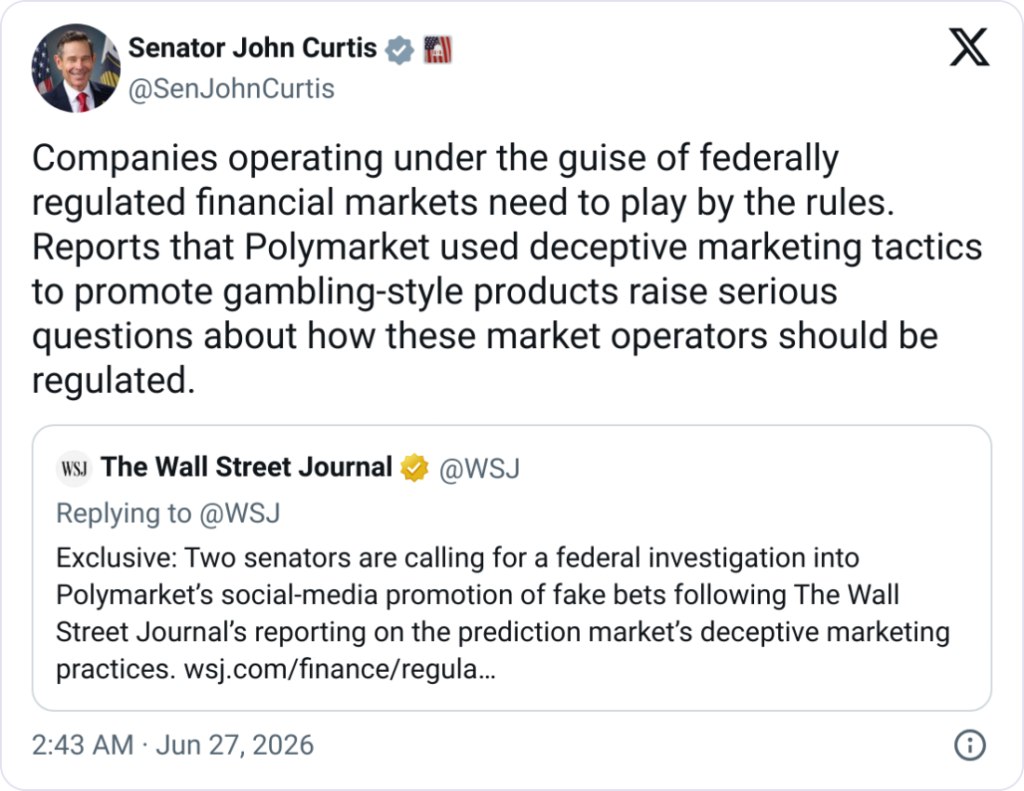
If confirmed, lawmakers argue that these marketing methods could violate consumer protection standards by blurring the distinction between authentic user activity and sponsored promotional content.
Following publication of the report, a spokesperson for Polymarket stated that the company had begun conducting an internal review of its active marketing campaigns. According to the company, the audit is intended to verify that promotional materials comply with internal policies as well as applicable legal and regulatory disclosure requirements.
The latest congressional request comes as reports have also emerged suggesting that the CFTC is already conducting an investigation into Polymarket’s operations.
According to media reports citing individuals familiar with the matter, federal regulators have been examining aspects of the platform’s business activities, although officials have not publicly disclosed when the inquiry began or what specific issues are currently under review.
Polymarket has declined to comment on both the reported investigation and the senators’ letter.
The controversy arrives during a period of rapid expansion for prediction markets.
Platforms that allow users to trade contracts based on the outcome of future events—including elections, sports competitions, financial indicators, and political developments—have experienced explosive growth over the past year, generating billions of dollars in monthly trading volume and attracting increasing attention from both investors and regulators.
As the sector continues to expand, lawmakers are questioning whether existing regulatory frameworks are sufficient to oversee platforms that increasingly resemble online gambling services.
In their letter, Senators Curtis and Schiff argued that prediction markets are frequently promoted to consumers as an easy way to generate profits rather than as financial instruments designed for legitimate risk management or hedging purposes.
The lawmakers suggested that marketing strategies emphasizing quick financial gains may encourage speculative behavior similar to gambling while failing to adequately communicate the risks associated with these products.
They also questioned whether event contracts offered by prediction market platforms provide sufficient public value to justify their treatment as regulated derivatives under existing commodities laws.
Beyond concerns surrounding Polymarket specifically, the senators raised broader questions about the CFTC’s ability to effectively supervise the rapidly growing prediction market industry.
According to the letter, the agency has repeatedly asserted that it possesses regulatory authority over these platforms because they operate under federal commodities regulations. However, the lawmakers questioned whether the Commission currently has the resources, expertise, and enforcement capabilities necessary to monitor an expanding market that increasingly overlaps with online betting and gaming.
The debate over prediction markets has intensified in recent months as several U.S. states have challenged the legality of event contract platforms.
In response, the CFTC has defended its jurisdiction by pursuing legal action against multiple states that attempted to restrict prediction market operators, arguing that federally regulated event contracts differ from traditional sports betting under existing commodities law.
To obtain greater clarity regarding the agency’s position, Senators Curtis and Schiff requested that CFTC Chair Mike Selig provide written responses to several questions by July 10.
Among the issues raised are whether the Commission is actively investigating Polymarket, whether the reported influencer marketing practices comply with federal law, and whether the agency possesses adequate authority and funding to effectively regulate prediction markets as their popularity continues to grow.
The outcome of both the reported CFTC inquiry and the congressional request could have significant implications for the future regulation of prediction markets in the United States. As these platforms attract larger audiences and higher trading volumes, regulators are expected to face increasing pressure to establish clearer rules governing advertising standards, consumer disclosures, and the legal distinction between financial event contracts and online gambling products.